The Temple Mount: The Heart of Jerusalem and the Story of God’s Dwelling
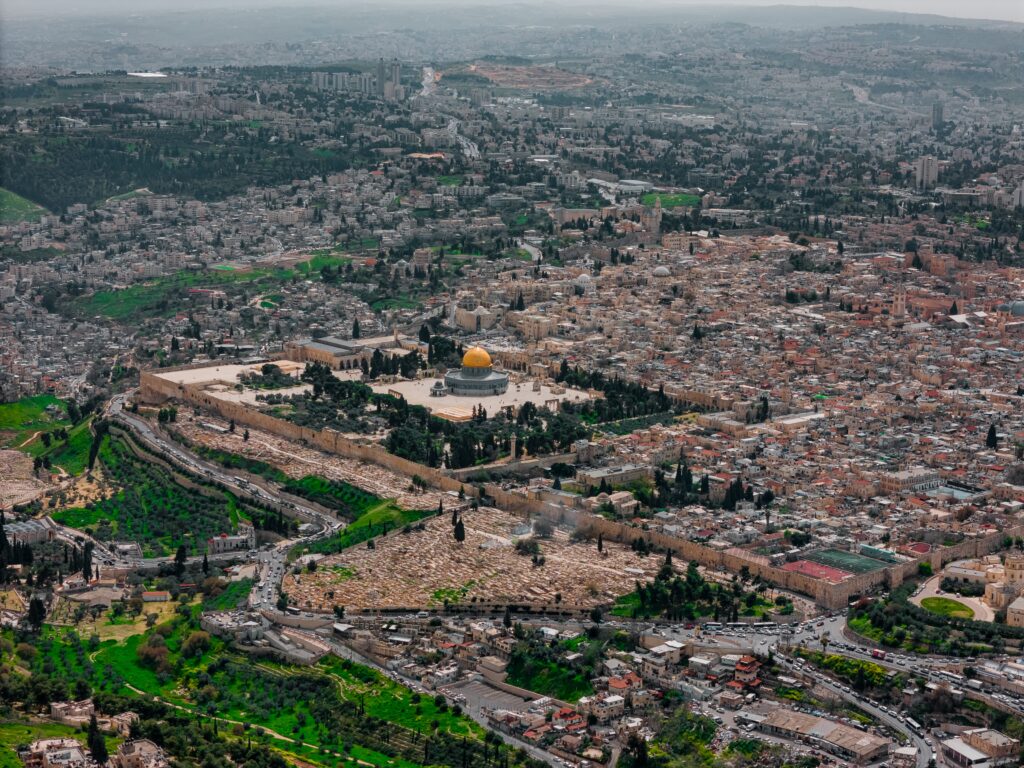
The Temple Mount is the most revered and historically consequential site in Jerusalem, long understood as the location of both Solomon’s Temple and the later Second Temple. Today it remains a monumental platform supported by massive Herodian retaining walls, preserving the footprint of the biblical world even though the Temple itself no longer stands. Rising above the City of David and commanding the center of ancient Jerusalem, the site served as the spiritual, national, and geographical heart of Israel. Its scale and elevation allow visitors to visualize the grandeur and centrality of the Temple in Scripture and understand why this mount became the focal point of Jewish worship and identity.
Biblical Significance: Identified with Mount Moriah (Genesis 22), the Temple Mount is the place where Abraham demonstrated profound faith, where David offered sacrifice to halt a devastating plague, and where Solomon constructed the First Temple—establishing a permanent dwelling for the name of the Lord (1 Kings 8). The Temple stood as the center of Israel’s sacrificial system, festivals, prayers, and national life. After the exile, the Temple was rebuilt under Zerubbabel and later magnificently expanded by Herod, becoming one of the largest sacred complexes in the ancient world.
In the New Testament, the Temple Mount is the setting of Jesus’ teaching, His confrontations with religious authorities, His cleansing of the courts, and His prophecies concerning the Temple’s future destruction (Matthew 24). It is where early believers met (Acts 2–3), and where Peter preached boldly after Pentecost. The site invites reflection on God’s holiness, His desire to dwell among His people, the costliness of worship, and the fulfillment of all these themes in Christ—who declared Himself greater than the Temple and whose once-for-all sacrifice superseded the system that once defined this mount. The Temple Mount holds together the story of promise, presence, judgment, and hope, reminding readers of God’s unfolding purposes through Israel and pointing ahead to His ultimate restoration.
Archaeology & Geography: The most visible archaeological features of the Temple Mount are the massive Herodian retaining walls, including the Western Wall and the Southern Wall. These stones—some weighing over 500 tons—testify to the engineering ambition of Herod’s expansion. The Southern Steps, still preserved, once served as the primary entrance for worshipers ascending into the Temple courts through the Huldah Gates. Excavations along the southern and western flanks have uncovered ritual baths (mikva’ot), street pavements, shops, and the remains of monumental arches such as Robinson’s and Wilson’s, which once supported access routes into the Temple complex.
Geographically, the mount sits atop the eastern ridge of Jerusalem, overlooking the Kidron Valley to the east and the Tyropoeon Valley to the west. Its elevation (approx. 2,430 feet above sea level) made it a commanding and highly visible center of worship. Directly south lies the City of David—the original urban core of Jerusalem—illustrating how the Temple’s placement reshaped the city’s development over time. The mount’s prominence allowed it to dominate the skyline of biblical Jerusalem, visible from the Mount of Olives, Mount Zion, and the surrounding hills. Its position at the ridge’s crest made worship both symbolic and geographic: God’s presence dwelling above His people, in the city He chose for His name.
Scripture References:
Genesis 22:1–14
2 Samuel 24:18–25
1 Kings 6–8
2 Chronicles 3:1–2
Ezra 3:8–13
Psalm 122
Isaiah 2:1–3
Matthew 21:12–16
Matthew 23:37–39
Matthew 24:1–2
John 2:13–22
Acts 2:46; 3:1–10